
Chat With Your Research Using Home
Having a research repository means customer knowledge compounds, rather than resets with each new study. But holding onto everything a team has learned isn't only a challenge for someone new to a project. The person who ran a study might not remember every detail of it six months later. And once you're deep in current work, noticing the same pattern across a few sessions raises its own question: is this actually new, or is it something your team already found and named?
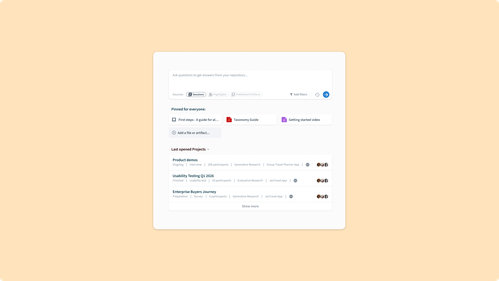
Home is the new starting point in Condens; an AI search that answers questions about your research in moments, alongside quick access to your projects and pinned resources for your team, all on one page. It's the first thing you see when you open Condens, built to get you oriented fast, whether you're doing a quick check on something or understanding what research already exists.
Getting oriented in a growing repository
A repository that's doing its job well keeps growing: more sessions, more tags, more published findings, month over month. That's a good problem to have, but it changes what "getting oriented" means. Reading through everything isn't realistic once a repository spans years of work, and most people don't need to. They need a fast way to see what's relevant to the question in front of them.
That's most true for the moments when you're approaching a repository from the outside: joining a project partway through, starting at a new company, or picking up an initiative you didn't work on from the start.
But it's just as true when you're already deep in your own work. Maybe you're the one who ran a study last quarter and want to check a detail you don't fully remember. Or you're a few sessions into something new, starting to notice a pattern, and want to know whether it's already been found and named before you build a hypothesis around it.
In any of these moments, a quick, natural way to ask "what do we already know about this?" and get a grounded answer makes a real difference, before you commit to reading through everything by hand.
Search your Sessions, Highlights, or Published Artifacts
At the center of Home is AI chat. Type a question the way you'd ask a colleague, "What have we learned about the free trial experience?" or "Has anyone researched checkout before?", and Home answers it directly, with the evidence linked underneath so you can check the source yourself.
Every search runs against one part of your repository at a time:
Sessions, for the full context of what participants actually said
Highlights, for the moments your team already marked as meaningful
Published Artifacts, for the conclusions your team has already reached and written up.
Filters narrow further by project, tag, date range, and more (depending on the source data type) within whichever scope you pick.
This is what makes Home a good fit for getting oriented. Say you've just joined a project midway through, or you're about to kick off something new and want a quick gut check on whether it's already been looked at. A scoped search gets you a grounded answer in seconds, evidence attached, without opening a single project by hand.
Where Home fits alongside your other Condens AI tools
It's worth being clear about what kind of tool Home is, because Condens has several AI-powered tools for structured analysis and stakeholder search:
The Insights Magazine AI search, available in Condens, in Slack and Teams, and through any MCP-compatible AI tool, is where stakeholders go to ask questions of your validated, published findings.
Ask your Sessions is where you do hands-on analysis: working through raw data, shaping findings, and getting tag and highlight suggestions as you go.
The Whiteboard's AI-powered affinity mapping is where you cluster and structure larger sets of highlights into patterns.
Home's AI search sits alongside all of these rather than replacing any of them. It's built for exploration: a question you're not sure has an answer yet, a first look at a topic before you commit time to it, or a check on what exists before you start something new. You can absolutely go deep with follow-up questions, Home will keep pace with you. But if you're ready to shape tags (at scale), build a structured analysis, or cluster findings across sessions, Ask your Sessions or the Whiteboard is where you go next.
Chat with your data
A good question rarely stops at the first answer. Home is conversational, so you can move from a broad question to a specific one the way a real conversation does, each follow-up building on the last.
Say you've noticed the same hesitation coming up in your last few sessions and want to check whether it's already been found. You might start wide: "Have we found anything about hesitation during setup?" Home surfaces the themes it finds: confusion during setup, unclear next steps, a drop-off point in the first session. To narrow in, you follow up with something more concrete: "Where did users describe hesitating during setup?" And to see it firsthand: "Show me the sessions where setup came up as a problem." Three questions in, you know whether you're looking at something new or confirming what's already there, without opening a single project by hand.
Questions with a concrete, findable answer get the best results. Something like "What exactly confuses people about setup?" asks for a conclusion, and that's a judgment call for you to make, since Condens AI doesn't do its own interpretation. What it will do is surface every relevant moment so you can draw that conclusion yourself, faster.

For more on writing questions and prompts that get the most out of Condens' AI-powered search, see our best practices guide.
Keep exploring, side by side
An answer is more useful when it doesn't disappear the moment you close the page, and it doesn't have to end there either. When a response is worth saving or sharing, turn it into an Artifact in two clicks, or drag and drop the answer block into an existing one.
Creating an Artifact from a response opens it in split-screen, right alongside Home, so the search isn't the end of the workflow. On one side, keep your answer open. On the other, dive into the Sessions, Highlights, tags, or Participants behind it, or run another AI search scoped to a specific page to keep narrowing in. If you're comparing two things, last quarter's findings against what you're seeing now, for instance, open a second Artifact next to the first and look at them side by side. The workflow stretches as far as the question does: start with an answer, keep it open, and build out from there.
From there, it becomes a finding like any other in Condens: something you can build into a report, share with your team, or return to later, still linked to the sessions it came from.
A starting point for the whole team
Home does more than hold a search bar. Quick access to your projects puts the work you're in the middle of right where you land, so you can pick up where you left off. Pinned resources give your team a shared starting point: you can point everyone toward the projects, findings, or guidelines that matter most, instead of leaving them to go looking.
This matters most for the people who touch research occasionally rather than daily. Someone new to the company can land on Home, see the pinned research for their area, and start asking questions on day one. Someone picking up a project they weren't part of from the start can pick up on existing work in minutes instead of asking around. And a research lead can curate what the whole team sees first, keeping everyone anchored to the same starting point.
Getting started
Home puts your research one question away. Open Condens, ask, and see what your team already knows. To learn more, visit the Help Center or reach out at hello@condens.io.

Iva is the Senior Product Marketing Manager at Condens, where she focuses on positioning, messaging, and G2M. With eight years in B2B SaaS, she's developed a real appreciation for the messy, ambiguous early stages of building where there's no playbook yet and the work gets to shape itself. She's passionate about grounding marketing in real customer insight and translating that into work that resonates with the people it's meant to reach.
