

How DigitalService Closed the Gap Between Research and the Rest of the Organization

The Challenges
- As the company grew, the need for consistent documentation and the ability to easily trace past findings back to their sources became essential.
- It was difficult to assess the relevance of existing insights.
- As their team grew, scaling knowledge management became more complex.
The Solution
- A structured research repository with separate project spaces.
- Insights magazines for internal and external stakeholder communication.
- AI assistance with data analysis, clustering, and tagging.
The Impact
- Researchers switching projects can quickly orient themselves on prior work.
- A research repository that suits their organizational structure.
- Analysis and note-taking are noticeably faster and more focused.
- Research has a company-wide influence
- Automated data deletion ensures GDPR compliance.
About the company
DigitalService is a subsidiary of the German federal government with a mission that sounds deceptively simple: bring agile product development and user-centered design into public administration. Founded in 2020, the company serves as the state’s in-house digitalization partner, designing, building, and operating cloud-native digital services. Its work is grounded in a user-centered approach, ensuring that products meet the needs of citizens, businesses, and public servants alike.
DigitalService’s first dedicated researcher joined the team in 2023, and by June 2026, the team had grown to ten researchers. Both researchers and designers are embedded within different project teams across a matrix organization. And as the team scaled, the question of where research should live, how it should be documented and shared, and who should have access to it became impossible to ignore.


Research was scattered across different tools
DigitalService has championed user-centricity from day one. Even without dedicated user researchers on every project, the teams have always stepped up to ensure user insights guided their decisions. The missing piece in this decentralized approach, however, was consistent documentation.
Before Condens, research lived wherever individuals stored it. Some teams used Confluence, and others stored files locally or in project-specific folders. As the company grew and team rotations became more frequent, the need to easily trace back past findings became essential.
Insights sometimes lacked the necessary context
In fast-moving projects where insights continuously informed decisions, reporting sometimes lacked the context required to sustain future utility (e.g., who was interviewed, how many participants, how old the data was).
So even a thorough-looking report could still require a fair amount of digging before you could tell whether the findings were still relevant and usable. As Ellen described it, you might find the insights, but then face a second question: Are they still reliable?
A growing team made structured knowledge management a necessity
When DigitalService's research team was just one to two people, informal knowledge management was sufficient. But when the team scaled to ten researchers spread across different projects, it became more difficult to manage.
After conducting a migration survey across the entire company to understand the scope of the problem, the finding was consistent: insights were hard to locate, harder to reuse, and their long-term impact was suffering as a result. Without a centralized repository, duplicate work was inevitable.
A structured repository built around the organization’s workflow
One of the first decisions the team made when rolling out Condens was about how to structure their workspaces. DigitalService operates as a matrix of project teams, with researchers embedded across multiple streams, so it was important to be able to keep some spaces separate, as different projects have different stakeholders, different data, and different access needs.
Condens's ability to create separate spaces within a single platform was, as Ellen described it, “one very important factor” in their decision to go with the tool.
Insights Magazines for external stakeholders
The team set up Insights Magazines for their external stakeholders from the start. Insights Magazines are a dedicated space in Condens where stakeholders can explore research findings at their own pace. The content, layout, and AI search are all scoped to what researchers choose to publish, so stakeholders get the insights that matter, without being overwhelmed with the raw data behind them.
For DigitalService, this solved a specific communication challenge: external stakeholders, including partners in government ministries, needed a way to access research findings without navigating through internal project spaces. Since sharing knowledge and insights is a fundamental goal of public-sector organizations, having a dedicated channel for research findings made it easier to disseminate evidence and support informed decision-making across teams and institutions.
AI as a research assistant, not a replacement
The DigitalService team evaluated Condens' AI features as part of the decision to adopt the tool, and found they aligned with how researchers actually want to work: as a support layer, not a substitute for human judgment. In practice, this means using AI summaries to get a quick starting point on a body of interviews, smart clusters to continuously organize highlights with no manual work, and the “find similar highlights” feature to surface related evidence that might have been missed otherwise.

Leonie uses AI in Condens to support her own analysis, quickly jumping back to check details on specific themes and identify blind spots.
„I think it’s good for my peace of mind. I’d think we have all the points. But it's also nice to sometimes have it summarized in a bit of a different way. It can also be a bit of inspiration.“
Ellen takes a similar approach by using AI to retrieve specific quotes or themes quickly, then applying her own interpretation.
„I use [AI] in the sense of like, ‘find me this and that’. But then I do the judgment myself.“
Rather than launching Condens to the whole company at once, the team identified a “champion” within each project; someone who would learn the tool deeply and then introduce it to their own team on their own terms. The research team used the time before the wider announcement to define their taxonomy, set up templates, and work through trial cases with a small group.
„It was a very nice idea with the Champions. I think that worked really well because it kind of ensured that we made small, more robust parts. And only once we had a very nice magazine to show, then we said ‘tada!’ to our colleagues.“
The magazine was central to that reveal moment. The team waited until they had something genuinely worth showing before going company-wide, leading with a finished, populated magazine so that colleagues could see the value immediately, not hypothetically. By experiencing the benefits firsthand, teams could then apply the same approach in their own projects and share research insights more effectively with their external stakeholders.
The company-wide launch happened during a lunch-and-learn session, only once the team felt ready to answer questions and had something they thought was worth showing.
Leonie estimates the internal setup phase ran from around December through to a company communication in February or March. That window gave the team time to iterate on their taxonomy, understand where they had over-engineered things, and simplify accordingly.
Researchers can hit the ground running on new projects
Because DigitalService researchers often move between projects, the ability to quickly understand what research already exists in a space is essential. Condens has made it much easier for new researchers on a project to get up to speed, find existing knowledge, and know who to reach out to if they need more context.
A research repository that fits how they work
Having all their research easily accessible in one centralized space matters for DigitalService because, as Ellen stated, “documentation and archiving (a lot of it) is really important for governments. So it’s really good to have everything in one place.”
At the same time, not all stakeholders should have access to everything. So they also needed a way to set up separate spaces.
Condens gives them exactly that: one secure, compliant space with the ability to create separate workspaces that fit how their organization works.
Analysis and note-taking are measurably faster
Before Condens, note-taking during sessions meant trying to capture everything in real time, with no transcript to fall back on. Now, Leonie can focus on capturing the ‘aha’ moments that matter, knowing that the transcript will take care of the rest.
Furthermore, revisiting an interview to look up a specific statement is now, as Leonie plainly says, “much, much easier.” It used to require hunting through multiple files. Now it's a keyword search away.
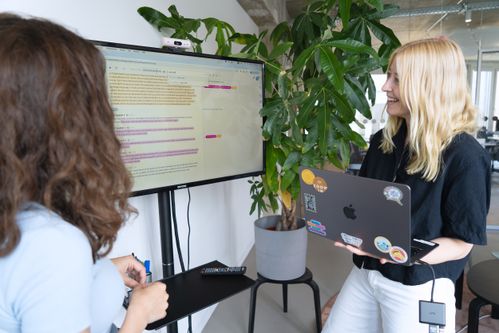
Ellen adds a concrete example of what this looks like in practice. When a colleague asked her to pull an exact quote from a past interview, she could find it immediately. That kind of retrieval used to be impractical.
Research reaches further inside the company
Beyond the repository itself, the team has built a recurring internal format called Voice of the User: a way to share anonymized highlight videos and research snippets with the wider company through an all-hands presentation. The easier highlight video creation in Condens has made this format practical to run consistently.
Compliance taken off the to-do list
Compliance with data protection regulations (especially when working with the government) is crucial for researchers. That’s why the ability to schedule automatic data deletion in Condens has helped remove an ongoing administrative burden and a potential compliance risk for the DigitalService team.
„It's nice because otherwise it’s like some tasks that you might forget about. This way, it’s out of your brain, and now you know it’s taken care of.“
Final Advice
Both Leonie and Ellen agree that the real test of long-term impact is whether a multidisciplinary team of both researchers and non-researchers joining a project can find everything they need without asking anyone. The early signs are there, as Ellen shared, “I do believe the more we nourish it, the more helpful it will be. I think we can now see signals of it.”
That patience is also reflected in Leonie's advice for any team starting with a research repository: begin by understanding your own organization's shape. What are your project structures, who are your stakeholders, and what access do different groups actually need? For DigitalService, the ability to create separate spaces was fundamental. Without that, the tool wouldn't have fit.
She also recommends not rushing the setup because a research repository is not a tool you configure once and walk away from. It evolves as the team's needs become clearer.
